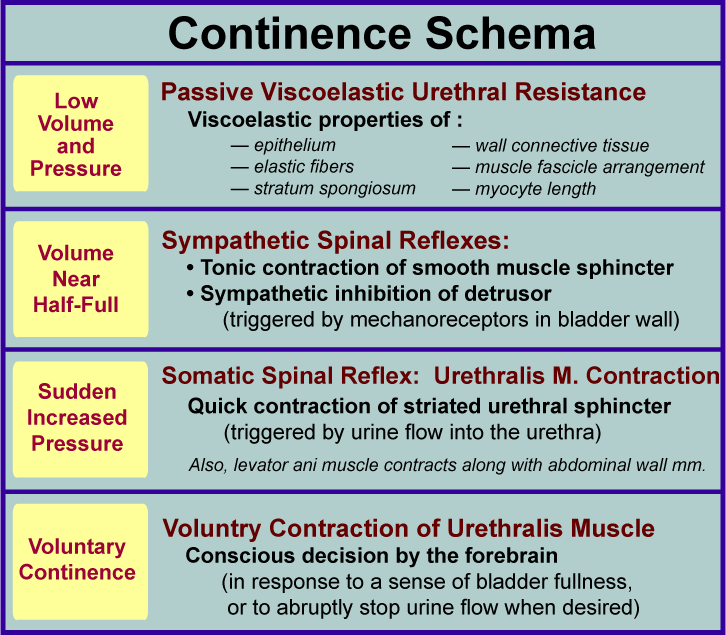
Urinary continence, the ability to store urine without leakage, requires that outlet resistance exceed intravesical pressure. Different mechanisms are involved depending on the intravesical pressure magnitude and rate of change. Initially, when bladder volume and pressure are low, passive viscoelastic resistance is adequate. As pressure increases, tonic active resistance is provided by the smooth muscle sphincter activated by sympathetic spinal reflexes. Sudden pressure increases are countered by spinal reflexes engaging striated muscle. The striated urethralis muscle is also used for voluntary continence.
esc closes window